Prior to my starting this program, my level of knowledge concerning Indigenous teachings and ways of knowing was… different. Less embarrassingly lacking and more sadly non-existent. I do not say this with any degree of pride; the grim reality of the matter was that truth and reconciliation was not at the forefront of the public consciousness (or at least my consciousness) the way it is now, so I had little context outside of Social Studies classes.
In the present day, I can safely say that my knowledge in this area is considerably improved, though far from complete or even moderate. Here are some examples of how FPPL has impacted my life, learning, and teaching.
#1: Learning ultimately supports the well-being of the self, the family, the community, the land, the spirits, and the ancestors.
Human beings are innately social creatures; just like any other animal in the biosphere, we do not operate independently of our surroundings. We crave meaningful connections with one another, our forebears, and our environment. No way of knowing or learning is superior or inferior to any other, just different or more unique to the individual. One of the examples that immediately springs to mind is the Christmas celebration at Nusdeh Yoh Elementary. On the last day before the winter break, students and their families were welcomed to the school’s gym to enjoy a pancake breakfast together. Santa and Mrs. Claus visited (with some Indigenous adornments), listened to children’s holiday wishes, and gifted them each a small candy bag. Even though I was only a substitute there to support for the day, I could feel the sense of community throughout the school. Wanting to show my support for this community as well, I helped with the cleanup after the kids had gone back to class for the day. A small gesture, but perhaps I wanted to show my own respect for the space and the surrounding land by tidying the mess.
#2: Learning is holistic, reflexive, reflective, experiential, and relational (focused on connectedness, on reciprocal relationships, and a sense of place).
As an educator, I’ve always found that students learn better when they are happy and relaxed. Although I’ve never pretended to be any kind of comedic wit, injecting jokes and levity wherever I can generally tends to go over okay. The students are also an excellent source of smiles and laughter, especially when they make their own humourous connections to their learning. In one practicum, I was describing the three types of plate boundaries in earth science: divergent, convergent, and transform. I started teaching students to do hand motions to remember them – move away for divergent, closer together for convergent, and rubbing sides of hands together for transform. In my P2 Science 8 class, some students started referring to the former two as “bye-bye” and “boom” boundaries, respectively. I love not only that they made such connections on their own, but shared them with me as well. In this way, the students were the ones teaching me by demonstrating an understanding of the material that I never would have thought of before. I told them that I intend to share this connection with every class I taught going forward.
A day that was funny and great
Were the kids describing Earth’s plates
Divergent says “bye”
Transform our stuff flies
And convergent’s “boom” is its trait.
A limerick I wrote in an exercise for another class describing the kids’ connection to earth science. By giving that room to make and share that connection, I feel that everyone in that room was enriched for it.
#3: Learning involves recognizing the consequences of one’s actions.
The connection to learning may seem immediately obvious for this one; a student acts out of line and is ultimately punished for it. Such things happen in classrooms every day, and I can’t deny this is part of the reality in working with children. I have had to take materials away from students when they were hitting each other with it rather making use of the time and resources devoted to the task at hand. The consequence for these actions was an Insufficient Evidence assessment for what was the big project of the unit (although if they had submitted a write-up or some ideas they could have gotten an Emerging at least). However, there is another side to this principle.
I encourage students to not only complete their work, but hang onto the worksheets once they are passed back rather than immediately tossing them into the recycle bin. My reason for this is quite straightforward – I want students to learn from their mistakes rather than ignore or fret about them. I believe this notion is the core of learning; how can one expect to learn without mistakes? I would much rather they would make an error on an assignment than a quiz, and better a quiz than a test. I also tend to take questions for tests and quizzes in part from previous work, so such things would be to students’ benefit.
#4: Learning involves generational roles and responsibilities.
Even though I am quite a bit older than the students I teach, I do not take it as read that I know more than them simply because I have existed for a longer period of time. I know full well that each my students has knowledge or skills that they could very well teach me if they were so inclined. In that spirit, when giving them bigger assignments and projects, I give them the expectations for the work without limiting them unnecessarily. I do this because I believe that students will surprise you given the opportunity.
During my last practicum, I gave students the direction to create a seismograph as the big project for the earth science unit. I provided the basic materials and the outline of my expectations, but beyond that I allowed them free reign. I told them to design and build their device, test it, then improve on it based on the results. The final products were as varied as they were creative. Some students chose to improve the aesthetic, making their seismograph look like a castle (complete with drawbridge!), others chose to make an A-frame style, while still others incorporated conveyor-belt-style machinery into their projects! By gradually releasing them to develop their own mastery, students impressed me with their innovative spirit, something I never would have gotten had I been more restrictive.
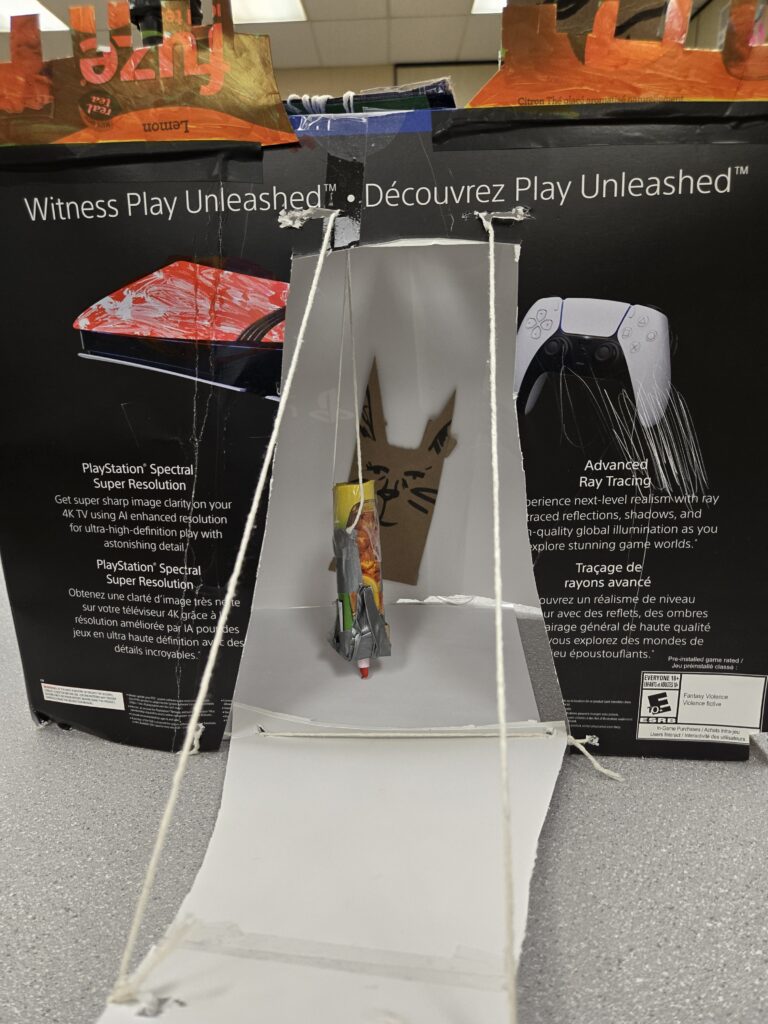
The “castle” style seismograph. I applaud my students’ sense of creativity!
#5: Learning recognizes the role of Indigenous knowledge.
I see myself not only as a teacher, but a lifelong student as well. As I outlined on my Lifelong Learning page, I never want to lose the perspective of someone learning something for the first time. If I’m not aware of how I process new skills and knowledge, how can I do so for my students? To that end, I have dedicated myself to continuously learning new things throughout my life. A good example is my picking up of a new skill for a class project. The Seven Grandfather Teachings and the animals associated with them have always resonated with me, so I wanted to do a project tied to that. Crochet plushies immediately came to mind, but there was one small problem. Outside of a single plushie made from a kit, my skills at crochet were beginner at best. I refused to let this stop me, however; I dedicated a month to re-learning and improving my skills, finding patterns online and creating seven animal plushies.
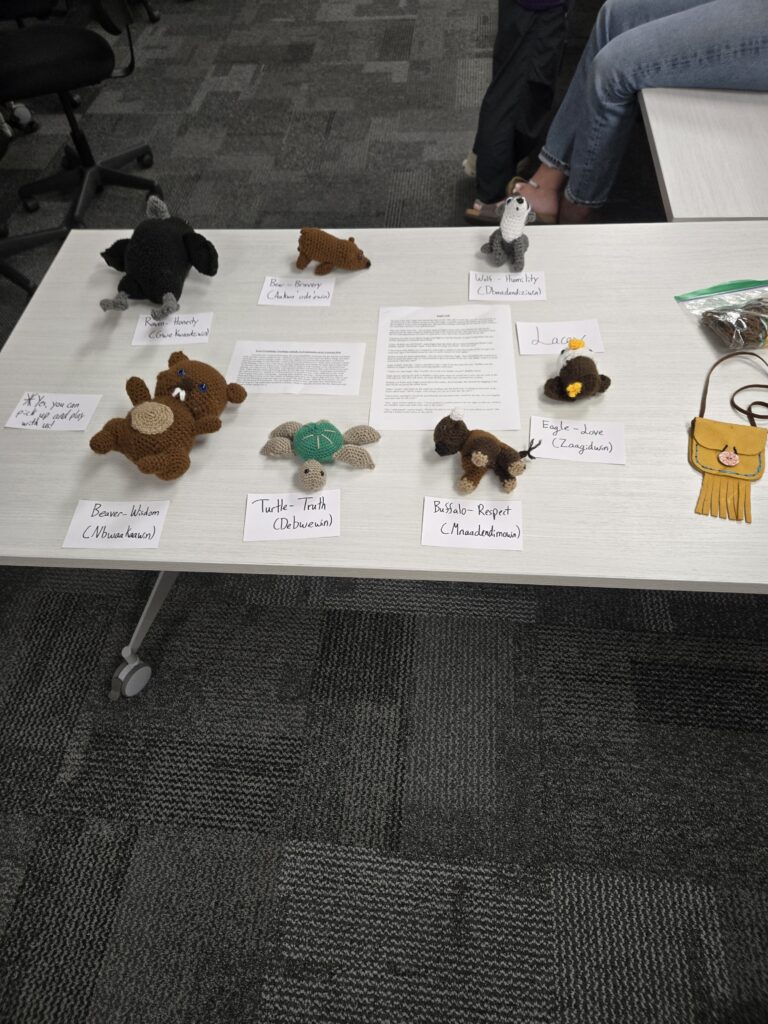
The seven crochet plushies of the Grandfather Teachings animals project I made. Learning the necessary skills and creating the plushies themselves took approximately a month. It gave me not only a new skill, but valuable insight into how I learn.
I learned very quickly about the ways in which I receive and process information. As it turns out, video tutorials were the best way for me to pick up new things – I could pause, rewind, and repeat any part as much as I needed and take things at my own pace. This got me thinking – could I maybe make a video series of my lectures for students? Would this help kids who are chronically absent for whatever reason? Could I use this to encourage students to pick up new skills or interests for themselves? Is learning new skills intimidating for some people? By viewing these ideas through an Indigenous lens, I really gained a new perspective as someone learning something for the first time. I hope to translate these ideas into my classroom going forward.
#6: Learning is embedded in memory, history, and story.
I have always been a storyteller by nature – whether writing my own or presenting facts in the form of a story, I have always believed that giving narrative structure to an idea or concept helps contextualize it. A good example comes from past practicums, in which I tell students stories of events related to the material at hand. I got an excellent chance to do this teaching earth science by describing major geologic events as recorded through human history and expressed in mythology.
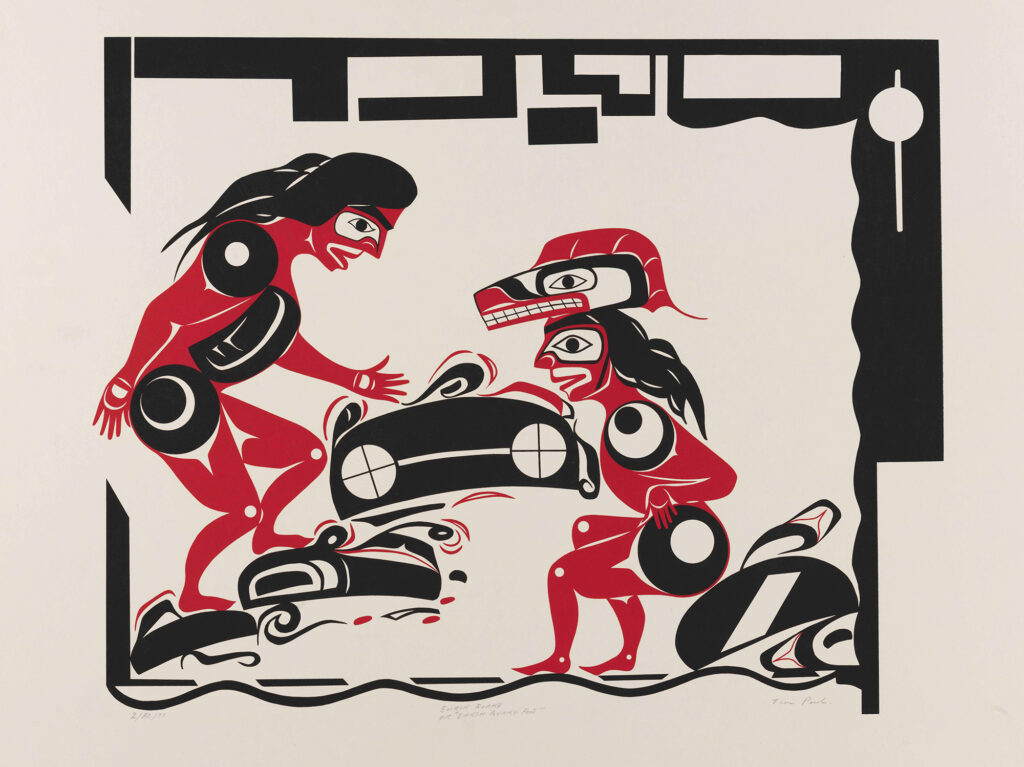
A First Nations picture of the legend of Earthquake Foot, a Mowachaht-Muchalaht story that demonstrates First Peoples understanding of how earthquakes worked.
Pictured above is the story of Earthquake Foot, in which a man dancing with mountain dwarves stumbles into their drum and is inflicted with the eponymous condition. Every step he takes causes the very earth itself to tremble. This story shows how First Peoples understood earthquakes – while not the same as Western explanation, it does show they understood that quakes had a starting point (focus). From that starting point, the quakes would radiate outwards and cause other events such as tsunamis, which Indigenous peoples were also very much familiar with. Although the explanations provided from these stories are not the same as those provided by Western science, there is some correlation to specific aspects that are understood by all with the information provided them. I give this story as an example of how different people understand similar ideas.
#7: Learning involves patience and time.
Likely the principle that strikes the strongest personal chord with me, I have striven to keep this idea in my mind as well as pass it along to my students. As a more-or-less straight-A student in school, I was accustomed to always understanding things immediately the first time. As I matured, though, I quickly realized that isn’t the case for me, never mind anyone else. It is a mindset I have struggled with since my own school days (although it can be argued that my school days are still continuing). I’ve also come to realize that true knowledge comes from application and extrapolation, not rote memorization and recall as traditional methods of teaching might have one believe.
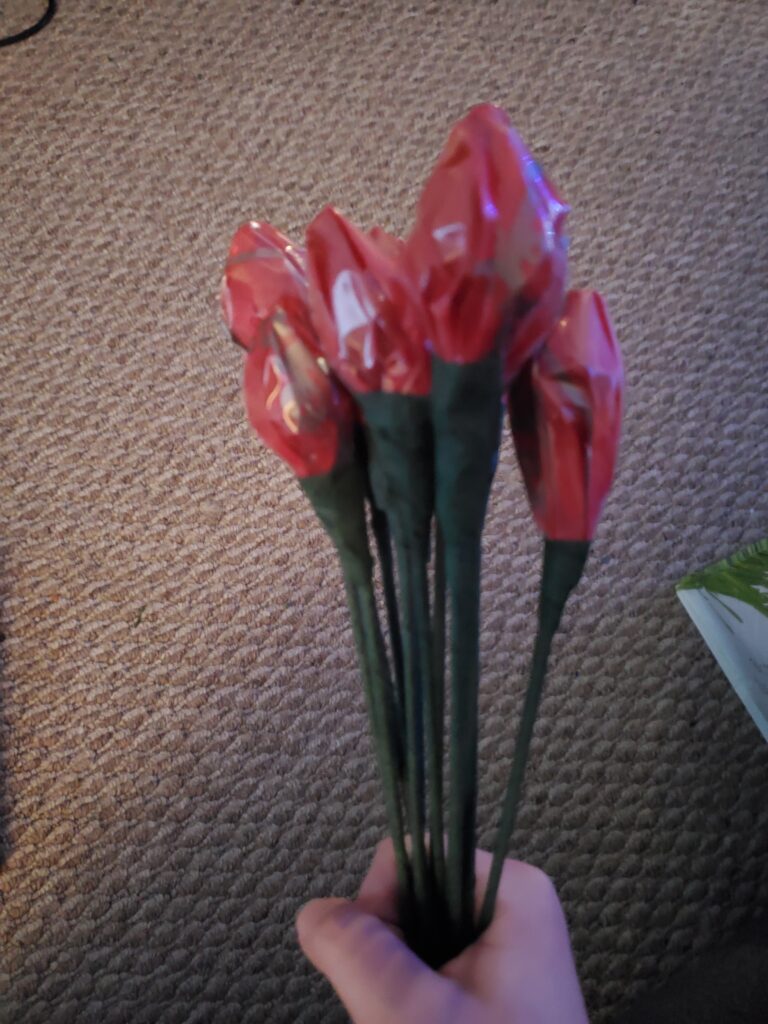
Hershey’s Kiss roses I made for my cohort’s Valentine’s Day craft table. It was only after the fact that I learned the green florist’s tape for the stems needed to be stretched to activate its stickiness. No wonder it wouldn’t stay!
While I have come to enjoy crafting in recent years, it hasn’t been without its pitfalls. Those roses pictured above might have turned out even nicer had I read the instructions for the florist’s tape! That way, I might have made even more rather than wondering why the so-called “tape” wouldn’t stick. This is also a mentality I wish to pass on to my students. There are times where we won’t get something the first, second, third, or even tenth time. Instead of getting stressed or frustrated, a broader viewpoint can be of greater benefit. What am I doing wrong? What is it I’m missing or misunderstanding? I certainly would not have been able to accomplish my crochet project in the timeframe I did had I not granted myself the necessary patience. Progress, not perfection, is the name of the game.
#8: Learning requires exploration of one’s identity.
As a secondary years educator, I recognize the fact that high school is a very turbulent time in a student’s life. They are going through biochemical, emotional, and mental changes, to say nothing of any extenuating circumstances that may or may not be present. They also have many facets of their identity that merit exploration: individual, sex, gender expression, race, family dynamics, physical (dis)ability, mental health struggles, financial difficulties, social problems, and so much more. All of this is on top of being expected to show up to school, attend all classes, and complete any and all assigned work. These factors can all create a psychological and sociological pressure cooker in a student’s mind, so being cognizant of these and giving them room to breathe is of great benefit to all involved.
As previously mentioned, I like to give students room to make their own connections with subject matter and provide their own personal touches to bigger projects. One reason I do this is because I believe that creative outlets are an excellent way for students to express their understanding in their own way. In so doing, I am giving them a chance to explore and develop their own identities in this “in-between” point in their lives. They are not little kids anymore, nor are they adults; I believe I shouldn’t treat them as either one of those. By giving them that space, they can have a chance to better understand who they are and who they are becoming.
#9: Learning involves recognizing that some knowledge is sacred and only shared with permission and/or in certain situations.
If there is one fault of which I have been painfully aware, it is that people tend to presume on or judge things of which they have neither experience nor knowledge. Despite the absence of any learned or lived experience, expectations are still formed nonetheless. The same rings true of Indigenous teachings – knowledge holders may be expected to provide every ounce of their knowledge just because it is asked of them. The reality is that some knowledge is specific to certain families, individuals, locations, or occasions.
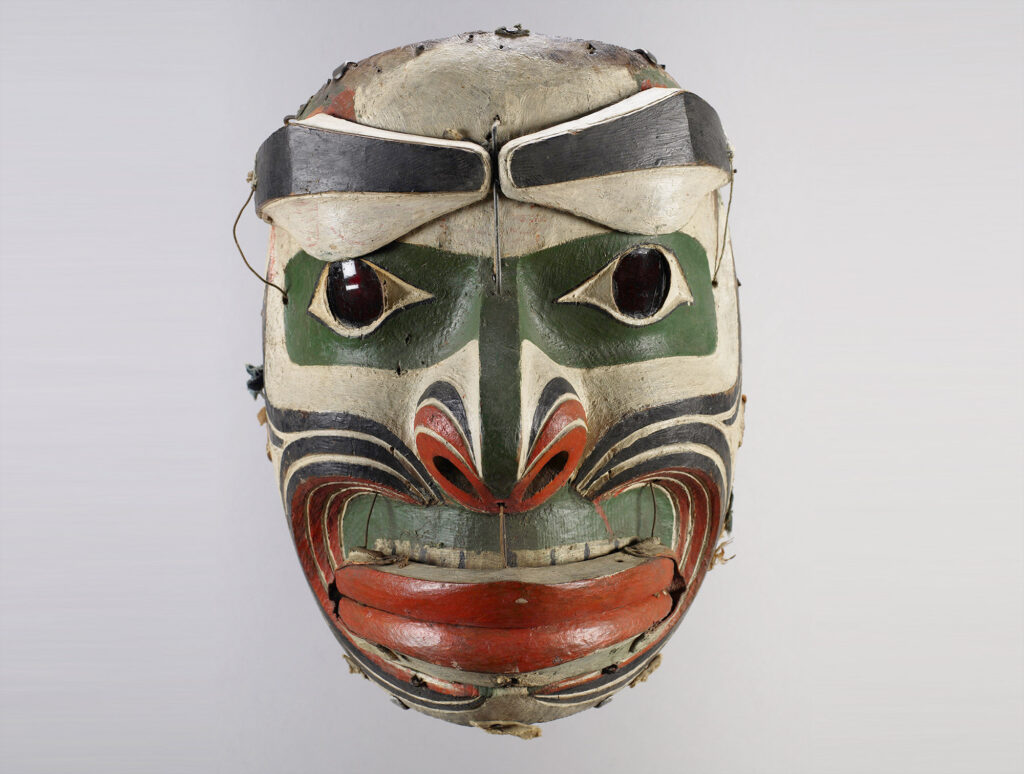
The Nininigamł (earthquake mask) and its relevant song, dance, and story are owned by at least two families in Kingcome Inlet.
The earthquake mask pictured above is one that I came across in my research for Indigenous knowledge regarding earthquakes. Crass would not even begin to describe the approach of simply demanding the knowledge from the families who hold it, especially without demonstrating reciprocity. The image and some information is available on UBC’s Shake Up website, but the intimate details are what connect those families to the land, their ancestors, and the stories that come from both. We must express gratitude for what is openly shared and respect for what is not.