As I have learned throughout the program, assessment does not merely involve grading. That would be assessment of learning, in which completed work is given a grade or proficiency level and handed back to the student. While useful, it is far from the whole picture and places too much emphasis on the products that students give us. Assessment for learning is much more immediate and gives students an idea of where their knowledge level is without fear of affecting their final grades.
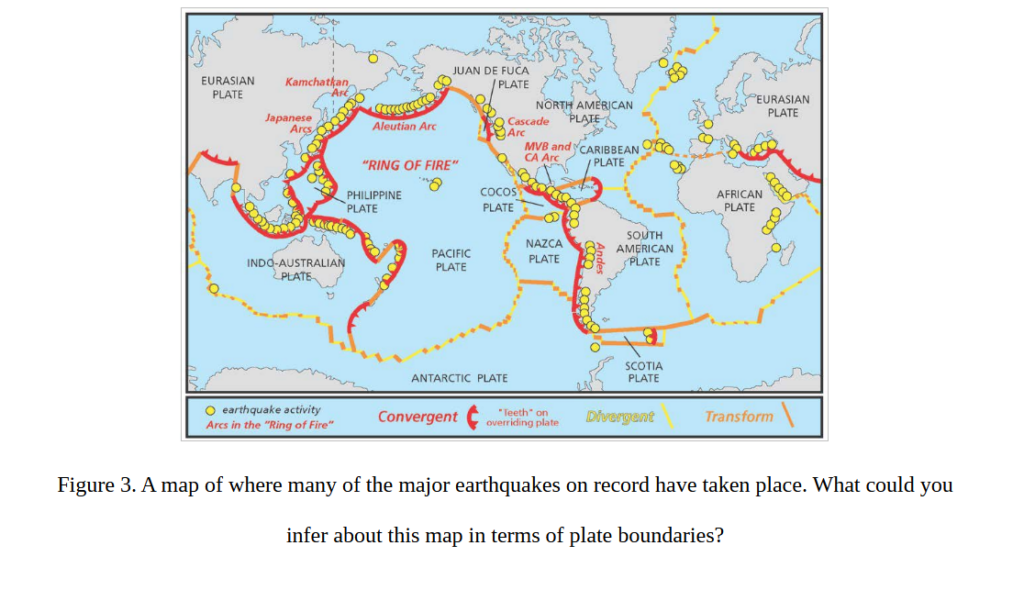
An excerpt from the notes of my mantle convection and earthquakes lecture. I would often include such questions with relevant images for students to contemplate during reviews. Perhaps I should start including these questions in the lecture proper.
One example I have used in the past is leading questions in the context of my lecture notes, such as the one pictured above. By including these, I wanted to give students a chance to ponder the information I’m currently giving them as well as previous knowledge on which I’m attempting to scaffold. On reflection, I could probably give blank spaces for students to record answers, include these questions in the lecture itself, and allot time for them to record and share out answers.
Another method I’ve enjoyed in the past is allowing students to illustrate for themselves what certain concepts should look like. As someone who can barely draw a stick person (but a pretty good Goomba!), I struggle with demonstrating this myself, but this is where I can allow students’ artistic talents to shine. Through visual representation, I can have students demonstrate knowledge in a way other than plain text or simple recall of facts. As long as I can at least kind of tell what I’m looking at (or the student can tell me themselves), then I can see that they are internalizing the current topics.
Finally, a favourite of mine is the mini-whiteboard, especially for review purposes prior to a big unit test. Instead of simply asking questions, I can have students show me their knowledge by writing down and holding up a small whiteboard. A method where I found this particularly effective is in the Jeopardy game. By using a template, I implement relevant “answers” to the test and have students provide the “questions” in the style of the show on which it’s based. Students can also keep their own scores on the whiteboard, adding a bit of mathematics to proceedings.
By presenting review material in this format rather than a boring worksheet, students can play and learn together rather than stare at yet another piece of paper. The candies I handed out at the end probably helped, too! At the end of the day, students were able to ascertain what they did and did not yet understand prior to a test in a more relaxed environment.